
An Indonesian Steam Odyssey
or a nostalgic retrospective on what was probably
Steam’s Last Chance to operate a Modern Commercial Railway
describing and including
Chris Newman’s 2008 Feasibility Report on Rail Traction Options
for a South Sumatra Coal Transportation Project
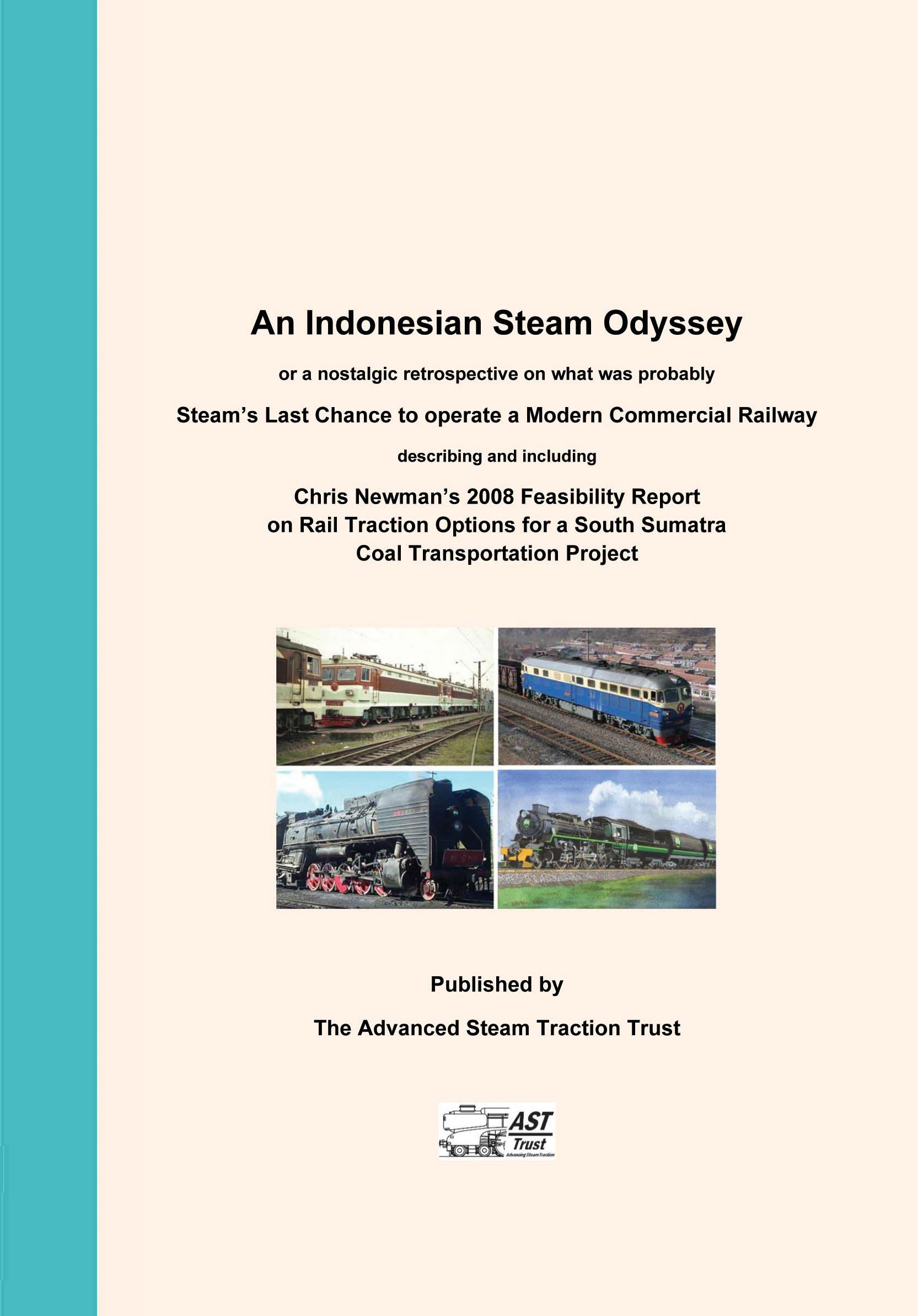
In December 2003, the author, Chris Newman, received an email out of the blue, enquiring whether he would be able to supply a fleet of steam locomotives to operate a planned coal haulage railway in Indonesia.
Chris was living and working as a self-employed engineer in China at the time. Two years earlier, he had become involved in establishing 5AT Project for which he acted as webmaster and primary contact person. It was the 5AT website that sparked the interest of the Indonesians and through which their enquiry was sent.
The 5AT Project aimed to build a high-performance express passenger locomotive that would be capable of hauling 400 tonne trains at a continuous 100 mph on level track. This, of course, would have been quite unsuitable for coal haulage, but Chris had been involved in conceptualising a design for a freight-haulage version of the 5AT, dubbed the “8AT”. He was also aware that China was in the process of replacing its vast fleet of steam locomotives with diesel traction, and that reconditioned Chinese QJ 2-10-2 locomotives might be a viable option for operating the Indonesian railway until such time as a fleet of 8AT or other modern steam locomotives could be designed and built to take over the railway’s operation.
David Wardale, of “Red Devil” fame and “father” of the 5AT Project, had recently returned to the UK after 12 years working and living in China. David put Chris in contact with a Chinese railway engineer named Wang Li Jie, who in turn, put him in touch with a Mr Yu, manager of a locomotive repair shop in Mudanjiang, in the far northeast of China. With locomotive performance data provided by Wang Li Jie and cost estimates provided by Mr. Yu, Chris was able to put together a comprehensive Feasibility Study that compared steam, diesel and electric traction options for the planned coal railway. In so doing, he demonstrated that the overall cost of steam would have been significantly lower than that for diesel or electric traction.
The introductory section of this book outlines the background to Chris’s “Indonesian Odessey”. The bulk of the book comprises the Feasibility Study itself. Some readers may dismiss the study as an “Indonesian Fantasy” – as it eventually became – but for a brief period, the opportunity for steam seemed very real. However, in 2008 the window of opportunity effectively closed when the last of China’s QJ locomotives were scrapped. At the same time, the Great Financial Crash eliminated any possibility of raising finance for the project, thus ending what was probably the last opportunity for steam traction to play a part in the modern commercial world.
The book fills 186 A4 pages including numerous monochrome and colour images.
Book price: £22.00 (less 20% discount to ASTT members) plus postage.
Unfortunately, we have had to withdraw the PayPal “Pay Now” button that we used to feature because PayPal no longer supports these. Until we can provide a viable alternative, could you please email your order to info@advanced-steam.org and we will send you an invoice offering options for payment via either BACS, PayPal or cheque. Please note that we charge 3% for PayPal payments to cover the fee that PayPal charges ASTS.
Please note: All proceeds from the sale of this book will accrue to Advanced Steam Traction Services Ltd. (ASTS), and will be used to fund its work of fostering improvements to the performance, reliability and/or economy of steam locomotives.