A Website Help section has been set up to guide AST members around the updated website and to show them how to make use of its new functions. Links to the Help pages can be found in the top menu on the left side of the page above the logo. Access to the pages is restricted to logged-in members only. Please contact the if you have any comments, questions, suggestions or criticisms.
Author: Chris Newman
-
Design for Reliability
A new page has been added under the Technical Menu heading titled “Design for Reliability“. It presents 28 points from a memo by David Wardale dated March 2005 in which he lists the factors that would have enabled the 5AT to offer much higher reliability than “first generation steam” (i.e. historic) designs.
-
Website Updates reported in Newsletter No 3
As reported in the News section, AST Newsletter No 3 was distributed on 23rd December. It contains an article describing several changes that have been made to the website. These are summarized as follows:
1 – Members’ Log-in: Members can now log-in to the site to gain access to Members-only sections of the website. All members should by now have received an email from the website inviting them to set his/her own password. Any member who has not received this invitation should notify and request registration. Once logged in, Members should be able to:
- access the Members’ Forum (see below) and make contributions to it;
- add contributions (posts) to other topics listed on the Forums page;
- propose new topics for the Forum.
- request email notifications of new posts on any Forum topic;
- post comments under News items;
- request email notifications of new News items (posts) and comments;
- submit News items (posts) for publication.
-
Newsletter No 3 Distributed 23rd Dec 2016
Members should by now have received a copy of AST Newsletter No 3 which was distributed by email on 23rd December 2016, a copy of which will be uploaded to this website in due course. In the meantime, any member who has not received a copy is requested to notify and request a copy.
-
Link created between AST’s Website and Facebook Page
A link has just been created between AST’s website and its facebook page through which News postings should automatically appear on the facebook page. This feature has only just been installed and has not yet been rigorously tested, so bugs may be found in it.
-
5AT Model on display at NRM
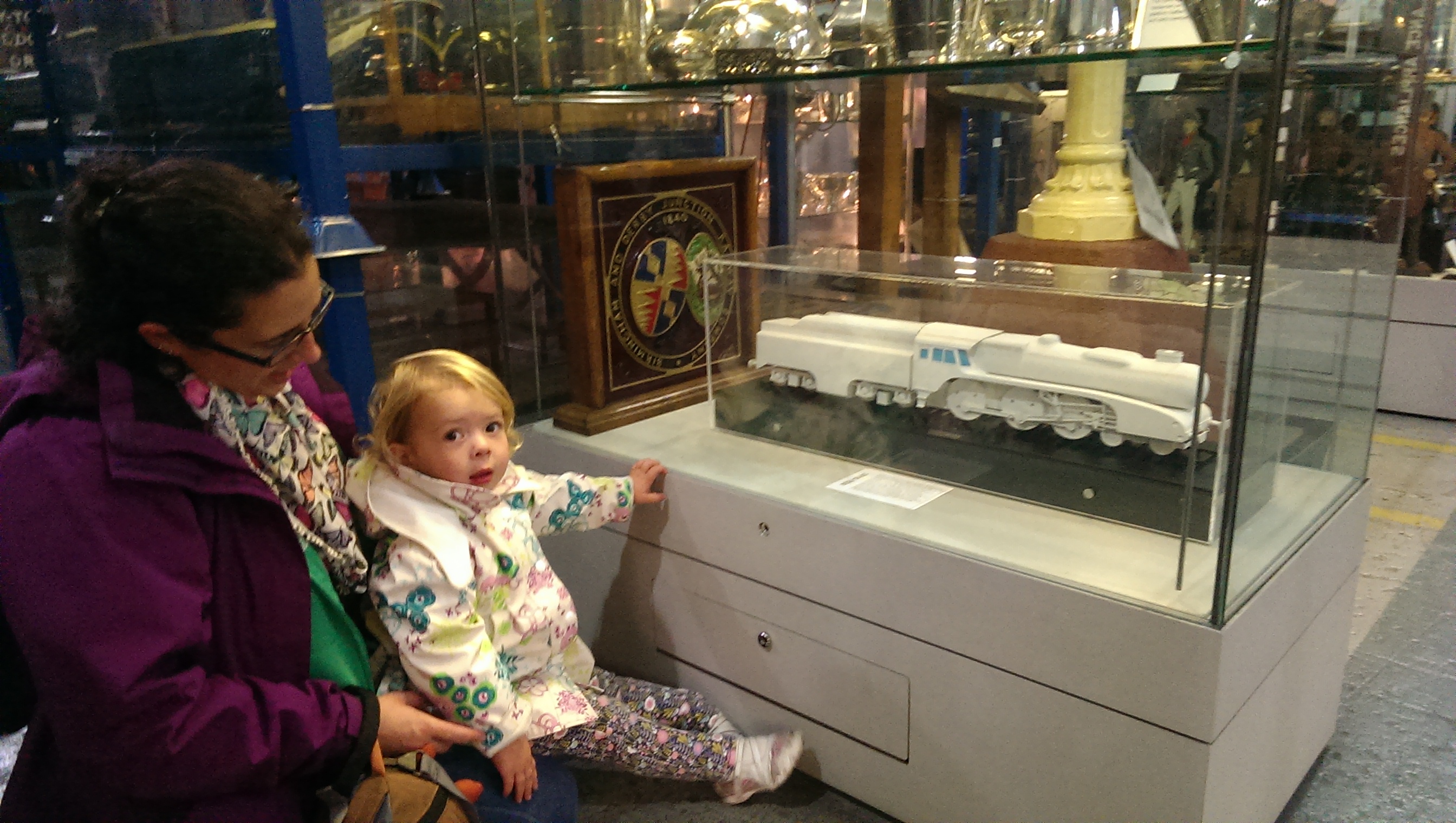
After attending the AST conference in Haworth on 9th October, William Powell travelled with his family to York where they visited the National Railway Museum. William was surprised (and pleased) to discover his model of the 5AT on display in the “Warehouse” section of the museum.
William built the 1 : 30 scale model in 2007 as his final year project at Bournemouth Arts Institute (see 5AT website) and loaned it to the 5AT Project for use as a visual display to accompany presentations that the group made from time to time.
Since the suspension of the 5AT Project in 2012, the model passed into the hands of the AST group. With William’s (retrospective) permission, AST donated the model, together with copies of the 5AT Fundamental Design Calculations and Feasibility Study, to the NRM in January 2016 (as reported in the Feb 2016 newsletter).
William, who joined the ASTT in 2016, is now a builder of miniature live-steam models. It may be hoped (and the suggestion has been lodged) that one of these days he builds a live steam model of the 5AT!
-
Haworth Conference
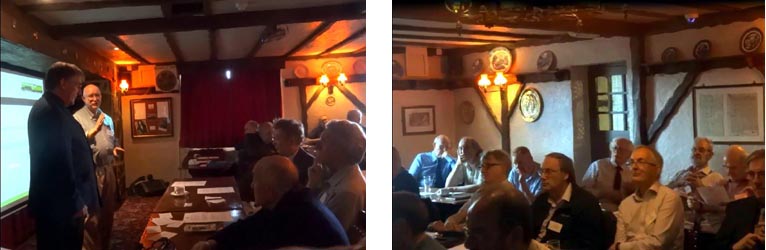
AST ran a successful conference in Haworth on 9th October 2016. The 30 attendees included the following:
AST Members: John Hind (chairman); Chris Newman (webmaster and membership secretary); Mike Horne (secretary); Paul Hibberd (treasurer); Jamie Keyte (committee member); Cedric Lodge (committee member); Richard Coleby (committee member); Adrian Tester; Alan Fozard; Andrew Taylor; Dave Pawson; David Hyde; Iain Jack; Ian Gaylor; John Boutwood; Les Turner; Nigel Thornley; Owen Jordan; Robin Pennie; William Powell; Xavier Jiménez (from Spain).
Non-members: Chris Hodrien; David Elliott; Graham Ashton; Neil Simkins; Nigel Simcox; Sean McKerchar; Sue Gaylor; Terry McMenamin; Vivien Vickers.
Apologies were received from 9 members and 18 non-members, their names being listed in the Conference hand-out.
Nine attendees took up the offer of free ASTT membership, bringing the total membership to 32.
Speakers:
- Mike Horne & Jamie Keyte: “Electronic Locomotive Indicating trials by ASTS Ltd”;
- Ian Gaylor: “The Design of ‘Lyn’“;
- David Elliott: “LNER P2 2007 Prince of Wales: Traditional Technology; Modern Methods”;
- Terry McMenamin: “Joy’s Motion for New-build LNWR ‘George V’“;
- Owen Jordan: “A Future for the steam locomotive?”.
Copies of the PowerPoint presentations for each of the above papers and video recordings of the presentations are available to AST members and to attendees of the conferences from the Haworth Presentations page. This page is password-protected. Please contact the if you would like to access this page.
-
February 2016 Newsletter
In October 2015, the Inaugural General Meetings of the Advanced Steam Traction Trust and Advanced Steam Traction Services Ltd. took place at Haworth. The remaining assets of the 5AT Group were transferred to the Trust, and the 5AT Group wound up. Both of the new companies are limited by guarantee and do not have share capital; the AST Trust has charitable status. The ASTS Ltd. is a wholly owned subsidiary of the AST Trust, and will be the organisation through which trading will be carried on. A Press Release has been issued announcing these developments, so you may see reference to the new companies in the media.
The officers and directors (Trustees) of the new organisations are as follows:
AST Trust:
- Officers:
- Chairman: John Hind.
- Director and Secretary: Mike Horne.
- Director and Treasurer: Paul Hibberd.
- Membership Sec: Chris Newman.
- Trustees:
- Richard Coleby
- Jamie Keyte
- Cedric Lodge.
ASTS Ltd:
- Chairman: John Hind.
- Director and Secretary: Mike Horne.
- Director and Treasurer: Paul Hibberd.
Membership:
The arrangements for accepting members to the Trust are set out on the accompanying paper: AST Trust Membership, which includes an application form. These documents are currently available on our website, but are included here for good measure.
Please note that membership fees fall due on 1 January each year, and payment by Standing Order would be appreciated since this saves both you and us time and cost.
Chairman’s Notes:To me this newsletter is pleasing as it is very much a joint effort, with contributions from Jamie, Chris and Cedric. The more we can share the burden of running the Trust and the Services Company the easier it is for all of us, so I am grateful that Cedric has taken over the production and editing of the newsletter from me.
We still need volunteers to ‘shadow’ and be ‘mentored’ by Chris in website management and by Paul in Companies House reporting. If the unthinkable were to happen, we will be in a very vulnerable position in these two vital ‘back office activities’, without anyone to take over the running of these vital functions.
So if you know of anyone who would be willing to help, please sound them out – our usual hourly rates apply – £0.00/hr but with the bonus of double time at weekends and triple on holidays……
I’d like to welcome three new Members to the company:
- Chris Ellick is Chief Engineer on 35028 (Clan Line) and currently overseeing its overhaul. Chris a practicing professional engineer, helps to bring our average age down, and is a living example of a new generation working to see the survival of steam on the mainline. Chris will be able to give us a valuable insight into the problems of operating main line steam in the 21st Century. In turn we can share our knowledge. Chris has joined through meeting Richard Coleby.
- Alex Powell is 19, and studying mechanical engineering; he lives in Oxfordshire. He is a budding live steam modeller, and has some experience in CAD. Alex has offered to help with engineering and technical matters, and also our web site.
- Les Turner has spent 25 years working as a volunteer with the Strathspey Railway. By profession, he is an accountant (retired).
Activities:
The following projects are now being handled by the ASTS Ltd:
Testing equipment: One of the essential requirements for our work on locos. is the capability of measuring
performance-before implementation of modifications, and after. Mike Horne and Jamie Keyte are developing a system which will enable such information to be recorded. An example of their system is described in relation to the work done with the Kirklees Light Railway, below.‘George V’: Feasibility study: In August, we put forward a proposal for a Feasibility Study for the LNWR ‘George V’ Steam Locomotive Trust, which is building loco No. 2013 – (Prince George), to recreate an example of a class of locomotive that was not preserved. To meet Railway Group Standards, the chimney will have to be reduced in height by 4 ins., and spark arresting equipment fitted. The combination of these two factors will reduce the draught on the fire and impact locomotive performance. The proposal was accepted very quickly. The Feasibility Study aims to understand the effects of the changes and make recommendations to counter these (while retaining the exterior profile with a reduced height chimney), and understand the effect on performance of an increased boiler pressure.
LMS ‘Patriot’ Feasibility Study: We put forward a proposal for this Project in July, to look at improved draughting, as the chimney needs to be reduced in height by 2 ins. To date, we have not received instructions to proceed, and the matter is in abeyance.
S160: Loco No. 5820: (KWVR.): This loco remains in traffic and has now had new superheater elements fitted. We have postponed testing on the loco pending carrying out testing on the Kirklees Light Railway. Once we have a date for the KLR testing, then John Hind will approach the K & WV Rly. to arrange a new date for 5820. Although a heritage railway, the KWVR is very busy, and securing acceptable dates can prove difficult.
Kirklees Light Railway testing: We have visited the railway twice last year, and John Hind and Mike Horne visited on Saturday 9/1/16, with Jamie joining in on a telephone conference call. Another visit is planned in early January to agree final details of the tapping points to which test probes will be attached. One of the problems that we have had to solve is measuring the piston displacement.
Lateral thinking and ingenuity from several members of the group (one of our many strengths) has enabled a novel method of measuring piston displacement using Hall Effect proximity sensors to be developed, and which are simple to install. Brackets and associated equipment have been made for fitting to KLR “Badger”.
We also have a number of transducers for measuring pressure and vacuum, thermocouples for temperature, batteries, and a Pico logger through which all of the data can be amassed on a laptop. Hopefully we can set a date for testing in the first quarter of 2016. A magnet is attached to the crosshead bracket and a Hall Effect sensor is fitted just forward of the mid-stroke position above the slidebar. When we do the logging we will get two pulses separated by a long and a short gap. The midpoint (on the time scale) of the short gap is the Forward Dead Centre position, and the midpoint of the long gap-the Back Dead Centre. Using this simple method we can determine speed and also construct indicator diagrams in combination with cylinder pressure. This is much more rugged and simple to install compared to conventional methods. The brackets and sensor were trial fitted to KLR “Badger” on Saturday (see photos below).
The equipment we have today was not available to steam locomotive engineers of the past, who would surely be astounded.
Once Jamie and Mike have done a bench test on all the equipment, then we can install on ‘Badger’.
The KLR are very cooperative and testing would not necessarily be limited to just one day; there is the option for going back for further tests if we do not get what we want out of the first tests.
Now that the method of measuring the piston displacement has been solved we are planning to test by the beginning of May.
Sales section:
David Wardale’s 5AT Fundamental Design Calculations (5AT FDCs) are now published in book form. The book combines the calculations and diagrams with a brief introduction by Wardale himself, and an introductory outline of the project by Chris Newman. These combine to form a soft bound tome consisting of 533 A4 pages, weighing almost 1.8 kg., and is being marketed through the 5AT and AST Trust web sites at a list price of £45.00 plus postage-see http://advanced-steam.org/5at-fundamental-design-calculations/. So far, 139 copies have been printed, of which 138 have been sold, with all the proceeds going to ASTS Ltd.
David Wardale’s ‘Red Devil’ book is now out of print, but if there were sufficient demand for additional copies, then it is conceivable that a further print run could be arranged. Sellers of second-hand copies are already asking silly prices for the book (as they had been before the last print run).
Donations to NRM York: On 19th Jan. 2016, Mike Horne and Chris Newman travelled to the NRM in York to meet curator Tim Procter, and to hand over to him the model of the 5AT built by William Powell in 2007, two printed copies of the 5AT Fundamental Design Calculations, and a copy of the last PPT presentation promoting the 5AT Project. Once these have gone through the NRM’s extensive cataloguing procedures, the model will be displayed in their ‘Warehouse’ section, whilst one copy of the FDCs will be placed in the public library section and the other in their archives.
Late news: As we ‘go to press’, news has just reached us that Wardale’s ‘Red Devil’ (SAR Class 26 No. 3450), is to be overhauled by Atlantic Rail, and used for steam excursions in South Africa. It is not clear at this stage how much of Wardale’s innovations will be retained; all, we hope!
Next meeting: Our next meeting-the AGM, will be held on Sat. 5 Mar. 10.30, at the NRM, Leeman Rd., York. The museum has excellent catering facilities and we believe that ‘Flying Scotsman’ will be in residence that weekend.
Future Newsletter Items: If you have any items which may be of mutual interest, please send them to me for inclusion in our next Newsletter.
Photos:
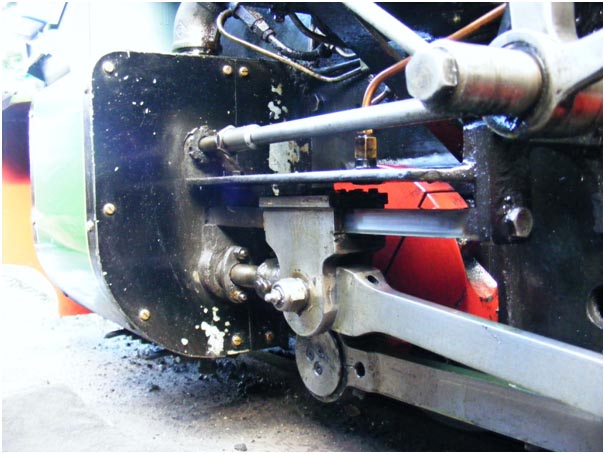
DSC9594 – Crosshead and slide bars on KLR ‘Badger’.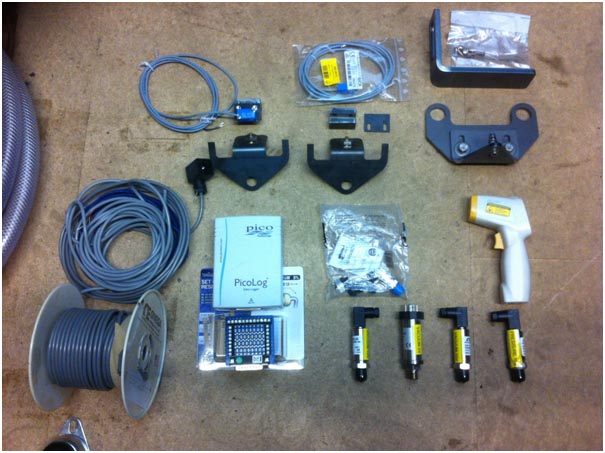
IMG1500 – Test equipment showing: top slide bar brackets and sensors (bracket for S160 on
the right). Lower left: Pico Logger and resistor board (for correcting inputs). Mid right: hand
held thermal sensor. Lower right: pressure transducers for vacuum and pressure.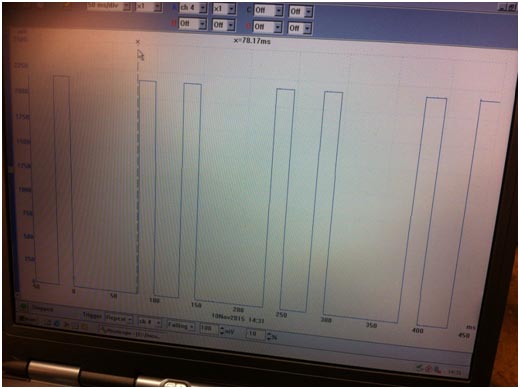
IMG1523 – Trial output of crosshead sensor on laptop screen. Pulses at unequal intervals
allow the Forward and Back Dead Centre positions to be determined.
GV-EXH-001 – Modified chimney: George V.
- Officers:
-
June 2015 Newsletter
Prepared by AST Chairman John Hind:
Group Status – Paul Hibberd and Mike Horne are currently working on the transition from 5AT Group to the AST Trust and Services. Both are now registered with Companies House, currently with them as the Directors.
Mike will be sending out details of the changeover shortly. Basically members of 5AT team will be invited to become members of AST Trust and the current Officers of 5AT group will be invited to become Trustees of the Trust.
A press release has been prepared for the ‘railway press’ announcing the formation of ASST, hopefully we should see it in the Railway Press during the coming weeks.
ASTT Inaugural Meeting – We are proposing that this takes place on the afternoon of the Saturday 24/10/2015 at Howarth. This coincides with the KWVR Beer & Music Festival which runs from the 22nd of October through to the 25th of October. The Beer and Music Festival runs all day and into the evening. As well as the trains running there is beer and music at the stations. Last year the timetable was more intensive than a gala, with plenty of opportunity for atmospheric evening running.
Holding the inaugural meeting in conjunction with an event like Beer and Music Festival makes it more worthwhile to those travelling a long distance and gives us the chance for a social event with a lot of atmosphere in the evening.
S160 – 5820 Project – we’ve just heard that a date in November has been set aside as the date for testing 5820’s new exhaust system. Despite the uncertainty, we have had started making preparations and Richard has made a set of brackets for mounting the draw-string potentiometer to the crosshead.
Kirklees Light Railway – This is linked to the S160 testing. As testing 5820 is going to be a unique opportunity, unlikely to be repeated, it’s best if we can get a chance to try out instrumentation on another railway or engine and learn from that. After looking round for a suitable cooperative railway, one of our network suggested the Kirklees Light Railway and through him contact was made with their Operations Manager, Ian Screeton. They have made some new blast nozzles for one of their engines and would like the vacuum measuring. This is a win/win situation as we all benefit.
Chris Corney, Mike Horne, Iain Jack, David Pawson and John Hind visited on Saturday 6/5/15 and had a productive afternoon discussing what Ian would like testing and also additional measurements that we would like to do to prove our equipment and techniques.
The line climbs continuously at 1 in 72, though with some easing at loops and stations. Line speed is 15 MPH and a single journey takes 20 minutes. Driving wheel diameter is 11″ and the engines run at circa 400 rpm. Although narrow gauge, they work hard for their living!.
The engines are fitted with GPCS and in addition to smokebox vacuum Ian Screeton would like to better understand vacuum in the firebox and ashpan. We will have to buy more instrumentation, but we will be able to use it on the S160 and hopefully other engines. Mike is currently updating the instrumentation shopping list.
The KLR give the impression of being very flexible, interested and willing. Ian Screeton is currently rebuilding an engine and could be interested in trying out improved features, which may be an opportunity for trying out enhancements to the exhaust system. Over the years they have had to rebuild their engines to improve reliability and they incorporate modern steam features, such as Lempor exhaust systems, GPCS, roller bearings, compensated springing with coil springs, self adjusting wedges on the axleboxes.
Clan Project – after burning some midnight (and beyond) oil, we issued this to the Clan Project on 9/4/15. It is 94 pages, has 34 charts, tables and CAD Images and 29 specific recommendations. Many thanks to all who contributed to this, which together with the S160 helps to demonstrate that we deliver what we commit to.
The recommendations were aimed at improving performance to Britannia levels and improve reliability. Principal recommendations are;
- increase boiler pressure
- installation of a single Lempor Exhaust System
- remove stress raisers from the frames
- fit multi-ring narrow piston valve rings including bronze ones
- adopt direct oil injection rather than atomisation for piston and valve lubrication
- steam injection into the primary air supply to eliminate clinkering and improve grate life
- adoption of a number of detail design changes to improve on BR Standard design features.
In carrying out the study through the use of 21st century problem solving techniques and CAD, we established a likely cause of the poor piston ring wear experienced with BR Standards that had the single slidebar arrangement. Piston rings required changing on average at 10,000 to 12,000 mile intervals and exceptionally at 5,000 to 6,000 miles whereas other BR standard classes achieved 25,000 to 36,000 miles. This is a problem that existed in the 1950’s when they were first introduced and is still with us in the 21st Century. We have suggested a modification to the slidebars supports and if it is adopted the ultimate proof will be actual piston ring ring wear. The same modification should also work on Duke of Gloucester, the Britannia’s and BR5s.
The report has been well received and we have been told verbally that the Clan Project want to adopt all the proposals. Their AGM is on 11/7/2015 at the Bluebell Railway and, post this meeting, there may be some movement. Clan Group have now paid the agreed fee which is now in the AST Services account, more on this later.
To date the Clan Project has acquired £400,000 worth of components and their current focus is on completing the frames, so they have something tangible to show for their efforts.
Other Projects – We are talking to two other new-build projects to see if they have opportunities for AST to have an involvement.
5AT FDC Publication – Chris Newman has recently published the 5AT Fundamental Calculations as a book. It is a weighty tome of 556 pages and not easy bedside reading! It is on sale to the public through the ASTT website for £45 plus postage and packing. All proceeds are going into AST Services’ bank account for use on AST projects. Copies of the book have been donated to the NRM and to the National Library. Only small batches are printed to meet customer orders so that minimal funds tied up in stock. The book is also being sold through Camden Miniature Steam.
Paypal & Bank Accounts – Paul has now established bank accounts for the Trust and its Services Company. To facilitate sales of the 5AT FDCs, a PayPal account has been set up by Chris.
The 5AT Group funds will be transferred AST Services’ account, ASTS being the trading arm of the Trust. ASTS’ account will also receive the funds raised from the CLIP Project and the funds from the sales of books.
Having these bank accounts moves us out of the ‘black economy’ of the Heritage Railway movement and is already showing benefits in the way we deal with our customers and suppliers.
Volunteers needed for “Back Office” Activities – the ‘back office’ activities now take on a new importance and volunteers who step forward to help managing these are just as important as those who do the ‘frontline’ engineering work. Volunteers are urgently needed as follows:
- Communications or Publicity Manager: A volunteer is needed to edit newsletters and take responsibility for press releases. Both are infrequent tasks but take time and are important.
- Assistant Webmaster: An assistant to (or stand-in for) Chris is urgently needed to help with the management the website.
- Assistant Treasurer: We now have to file annual returns to HMRC (the first one for the Trust is now due), so a volunteer is urgently to help Paul and to learn what is required. If we do not make returns on time, the Trust or the Services Company could be fined.
Sustainability – Over the coming years it is essential that we train successors to run the Trust and carry on the work that we are doing. This can only be done by attracting new and younger members. One potential source of news members are those who purchased the re-prints of the Red Devil and/or the 5AT FDCs. Another is the younger generation of steam enthusiasts who have grown up in the Heritage Movement and have an interest in improving steam.
We need to encourage younger enthusiasts and invite them to join our group. Ian Jack’s 5AT Facebook Group has a number of younger members who are volunteers in the Heritage Railway movement and are interested in what we are doing. We need to encourage their interest in joining us. The formal launch of the AST Trust will present an opportunity to recruit new members.